


Your Financial Review of October 2026
Balance Under Strain
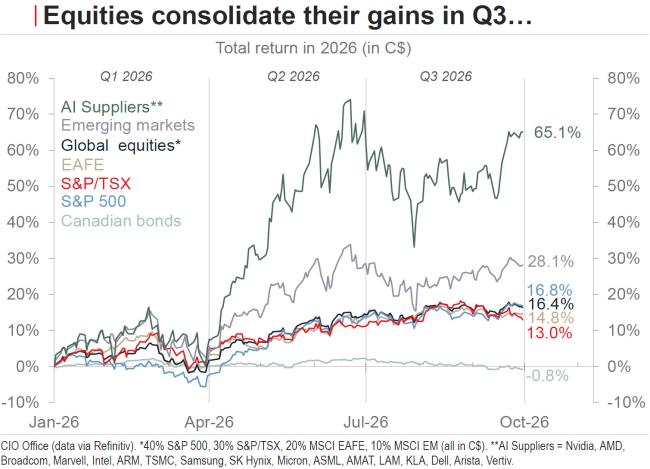
The third quarter of 2026 ended on a mixed note. On one hand, equity markets continued to advance despite several sources of concern. On the other, bond markets faced mounting pressure as long-term interest rates moved higher. This divergence was the defining feature of the quarter. Global equities posted modest but positive gains, while Canadian bonds declined as rising yields weighed on returns.
The quarter began amid heightened uncertainty. In July, renewed tensions between the United States and Iran triggered a sharp increase in oil prices and revived inflation concerns. Markets were also shaken by a correction in artificial intelligence-related stocks, particularly in South Korea and Taiwan. This pullback ultimately proved to be more technical than fundamental in nature. Corporate earnings remained solid, and growth expectations tied to artificial intelligence investment continued to support investor sentiment.
Throughout the summer, economic data continued to point to a resilient U.S. economy. Growth remained firm, the labour market stayed close to balance, and corporate earnings generally exceeded expectations. At the same time, inflation moved in a more encouraging direction than during the first half of the year, although higher energy prices continued to create some pressure. The Federal Reserve nevertheless adopted a more hawkish tone, raising its policy rate for the first time since 2023 and signalling that additional increases could be considered. This shift helped push U.S. bond yields to levels rarely seen since the global financial crisis of 2008.
Equity markets demonstrated a notable ability to adapt. Following the pullback among several large technology companies in July, leadership broadened to include other sectors and regions. Emerging markets maintained their lead year to date, while Canadian, U.S. and international equities all continued to generate positive returns. Valuations also remain reasonable in several regions when compared with levels seen over the past decade.
For diversified investors, the quarter was a reminder that markets can advance even when uncertainty remains elevated. Geopolitical tensions, debates surrounding inflation and movements in interest rates all contributed to volatility, yet corporate earnings and economic growth have so far allowed equity markets to maintain their positive trend. Discipline and diversification remain valuable when different asset classes appear to be sending conflicting signals.
Market Review as of September 30,2026
Fixed Income
Canadian bond markets experienced a difficult quarter. Following a decline of 3.0% in the third quarter, the FTSE Canada Universe Bond Index posted a loss of 0.8% year to date as investors demanded higher yields amid elevated energy prices, inflation concerns and growing government financing needs.
Long-term Canadian government bonds were among the hardest-hit segments, declining 6.4% during the quarter and 3.2% year to date as bond yields moved higher.
Canadian corporate bonds proved somewhat more resilient. Despite a quarterly decline of 2.2%, they were essentially unchanged year to date at 0.0%.
Equities
In Canada, the S&P/TSX1 gained 13.0% year to date, including a 1.6% advance in the third quarter, supported primarily by the energy, materials and financial sectors.
South of the border, the S&P 5002 returned 12.7% year to date and 2.3% during the third quarter. Despite higher interest rates, earnings growth and ongoing investment related to artificial intelligence continued to support the U.S. market.
International equities, represented by the MSCI EAFE2,3 Index, generated a return of 10.8% year to date and advanced 0.9% in the third quarter. Corporate earnings and continued economic growth contributed to these gains.
Commodities
Oil (WTI4) continued its strong advance in 2026, rising 69.7% year to date, including a gain of 37.7% in the third quarter. Tensions in the Middle East and ongoing disruptions along key shipping routes helped keep energy prices elevated.
Gold2 (US$/ounce) increased 3.2% during the third quarter but remained down 3.7% year to date. Strong central bank purchases and ongoing safe-haven demand helped offset the negative effect of higher real interest rates.
The broad commodity index (GSCI2,5) advanced 55.2% year to date, reflecting the strength of energy markets as well as sustained demand for several industrial metals.
Currencies
The Canadian dollar weakened by 0.3% against the U.S. dollar during the third quarter but remained only 3.7% lower year to date. The strength of the U.S. economy and expectations for higher interest rates continued to support the U.S. dollar.
Over the medium term, the balance of risks appears somewhat more favourable for the Canadian dollar, with the base case calling for a gradual appreciation toward 1.33 USD/CAD by the end of the second quarter of 2027.
1. The S&P/TSX Index is the main Canadian stock index measuring the performance of the Toronto Stock Exchange.
2. Returns for the S&P 500, MSCI EAFE, the GSCI Index, and gold are expressed in U.S. dollars.
3. The MSCI EAFE Index is a stock market index designed to measure the performance of equity markets in developed economies other than the United States and Canada.
4. West Texas Intermediate (WTI) crude oil is the North American benchmark for oil pricing. The return is expressed in U.S. dollars.
5. The GSCI broad commodity index measures the price movements of a diversified basket of commodities including energy, metals and agricultural products. Returns are expressed in U.S. dollars.
Outlook
According to the CIO Office’s base-case scenario, global economic growth remains sufficient to support equity markets, even though risks have increased in recent months. Corporate capital spending remains elevated, particularly in infrastructure linked to artificial intelligence, while earnings generally continue to surprise on the upside.
Three factors will warrant close attention through year-end. The first is the direction of energy prices. A meaningful and sustained easing would help reduce inflationary pressures and contribute to greater stability in bond markets. The second involves central banks. After several months characterized by expectations for higher policy rates, investors will continue to watch inflation and labour market data closely to assess how far monetary authorities may need to go. Finally, geopolitical risks, particularly in the Middle East and in trade relations between Canada and the United States, are likely to remain important drivers of market confidence.
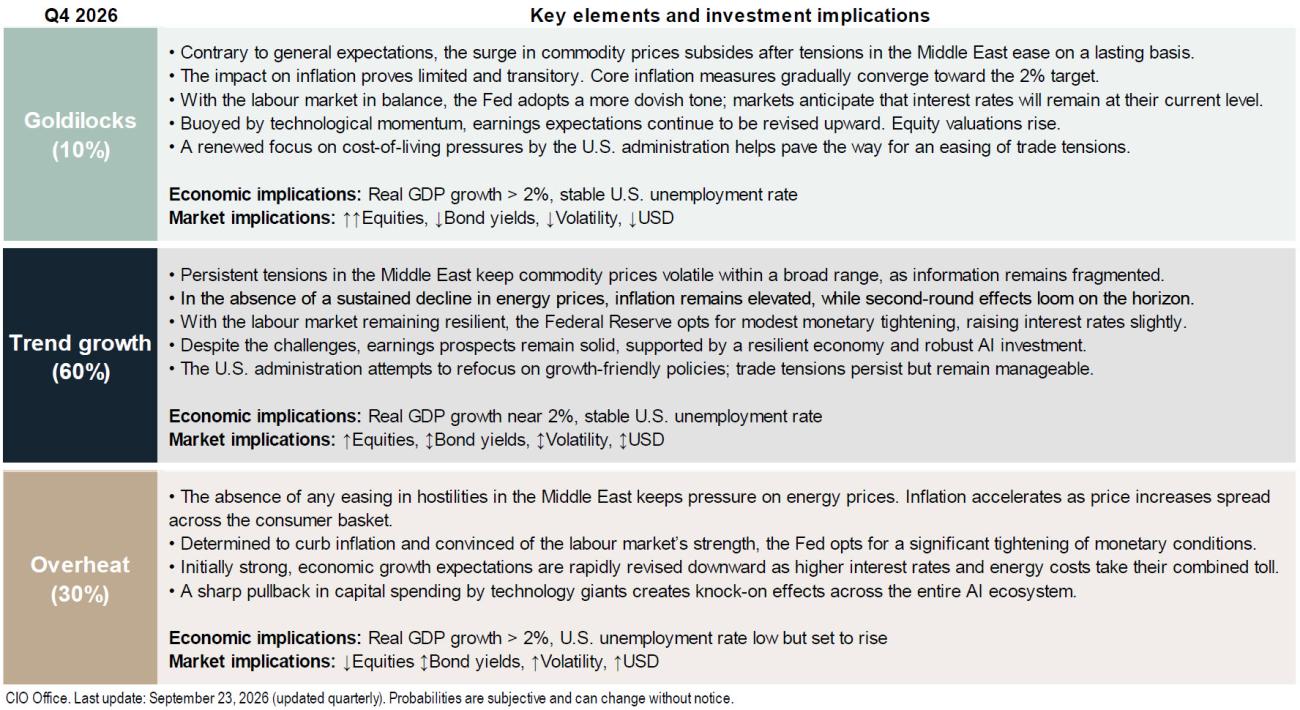
In summary, markets face more challenges than they did at the beginning of the year, yet the economic foundations supporting risk assets remain in place. In this environment, maintaining diversification across both asset classes and geographic regions continues to be essential.
Thank you for your trust. We remain available to discuss these perspectives and their impact on your portfolio.
Sincerely,
Cathy, Guillaume, Marc-Antoine and Inuk
514-871-3474