


Your Financial Review of July 2026
Markets Seeking Balance
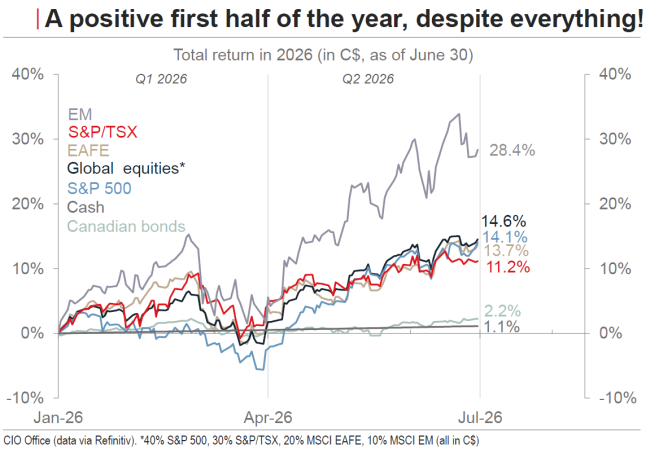
The second quarter of 2026 unfolded in a more favourable financial environment than appeared likely at the beginning of the year. Despite the challenges encountered during the first half of 2026, equity markets posted solid gains, supported by easing geopolitical tensions, the resilience of the global economy and the continued enthusiasm for artificial intelligence. Emerging markets stood out in particular, notably thanks to the contribution of Taiwan and South Korea, two economies closely tied to the semiconductor value chain.
The main development during the quarter, however, was the sharp decline in energy prices. After representing a significant risk for the global economy, tensions in the Middle East now appear less acute, while the gradual resumption of maritime traffic through the Strait of Hormuz is reducing pressure on supply chains and gasoline prices. This improvement removes an important headwind, without fully eliminating the risk of renewed episodes of volatility.
From a macroeconomic standpoint, the baseline scenario remains one of growth close to potential, accompanied by a stabilization in commodity prices and a gradual slowdown in inflation. Inflation is nevertheless expected to remain above target for some time, keeping the Federal Reserve in a delicate position, especially as markets closely monitor the evolution of U.S. monetary policy.
Artificial intelligence continues to play a central role in market dynamics. Profit growth remains particularly strong among companies linked to chips and memory, but the increased concentration around this theme makes markets more vulnerable to any disappointment regarding the pace of capital spending or earnings growth.
In short, the first half of the year gives way to a constructive, yet cautious, stance. The macroeconomic backdrop remains supportive for equities, but the balance remains fragile and requires close attention to inflation, the Federal Reserve, energy markets and investments related to artificial intelligence. In such an environment, diversification remains highly relevant.
Market Review as of June 30,2026
Fixed Income
The Canadian bond universe posted a positive return in June, supported by the normalization of energy prices, which led to lower inflation expectations and allowed bond yields to decline.
The Canadian bond index advanced 0.5% in June and 1.9% in the second quarter, bringing its year-to-date return to 2.2%.
Canadian corporate bonds also contributed positively, with a return of 0.3% in June, 2.0% in the second quarter and 2.2% year to date.
Equities
Global equities ended the second quarter with significant gains, even though volatility increased in June in the most popular segments of the year, particularly technology sectors.
In Canada, the S&P/TSX1 rose 0.5% in June, 7.0% in the second quarter and 11.2% year to date, supported by the strong contribution of the financial sector, which stood out with a 25.6% gain in the second quarter.
U.S. equities declined 1.0% in June, but the S&P 5002 still posted a gain of 15.2% in the second quarter and 10.2% year to date.
International developed-market equities (MSCI EAFE2,3) advanced 11.1% in the second quarter and 9.8% year to date, benefiting from easing energy-related tensions and a more favourable global economic environment.
Commodities
Oil prices fell sharply in June following the signing of an agreement between the United States and Iran, allowing for a gradual resumption of maritime traffic in the Persian Gulf.
WTI4 (US$ / barrel) declined 22.6% in June and 31.4% in the second quarter, but remains up 23.2% year to date.
Gold2 (US$ / ounce) also experienced a sharp decline in June, falling 12.1%, bringing its quarterly performance to -12.7% and its year-to-date return to -6.7%.
Despite the recent improvement in the energy backdrop, low inventory levels and underlying geopolitical tensions suggest that the balance remains fragile.
Currencies
The U.S. dollar appreciated sharply in June amid a recalibration of expectations related to Federal Reserve monetary policy.
The DXY index2,5 rose 2.3% in June, 1.2% in the second quarter and 2.9% year to date.
The U.S. dollar appreciated particularly against the Canadian dollar, with a 2.9% increase in June and a 3.4% gain year to date on the CAD/USD pair.
Over the medium term, however, the balance of risks appears more favourable for the Canadian dollar, with the baseline scenario anticipating a gradual appreciation toward 1.33 USD/CAD by the end of the first quarter of 2027.
1. The S&P/TSX Index is the main Canadian stock index measuring the performance of the Toronto Stock Exchange.
2. Returns for the S&P 500, MSCI EAFE, the DXY Index, and gold are expressed in U.S. dollars.
3. The MSCI EAFE Index is a stock market index designed to measure the performance of equity markets in developed economies other than the United States and Canada.
4. West Texas Intermediate (WTI) crude oil is the North American benchmark for oil pricing. The return is expressed in U.S. dollars.
5. The U.S. Dollar Index (DXY) is composed of a basket of six currencies weighted against the U.S. dollar. It includes the euro, Japanese yen, British pound, Canadian dollar, Swedish krona, and Swiss franc.
Outlook
The outlook for the second half of 2026 remains constructive, but within a framework that requires greater selectivity. The easing of tensions in global energy markets improves the outlook, while the baseline scenario continues to favour economic growth close to potential.
The dominant downside risk is no longer primarily stagflation, but rather economic overheating, where growth remains present but inflation becomes more problematic.
That said, investors should continue to keep a close eye on three major areas of concern. The first remains inflation, which should slow if the decline in energy prices is sustained, but which remains above target. The second relates to the Federal Reserve, as markets anticipate the possibility of rate hikes and communication from the new chair remains a source of uncertainty. The third concerns artificial intelligence, where massive investments are supporting profits but also increasing market sensitivity to any potential disappointment.
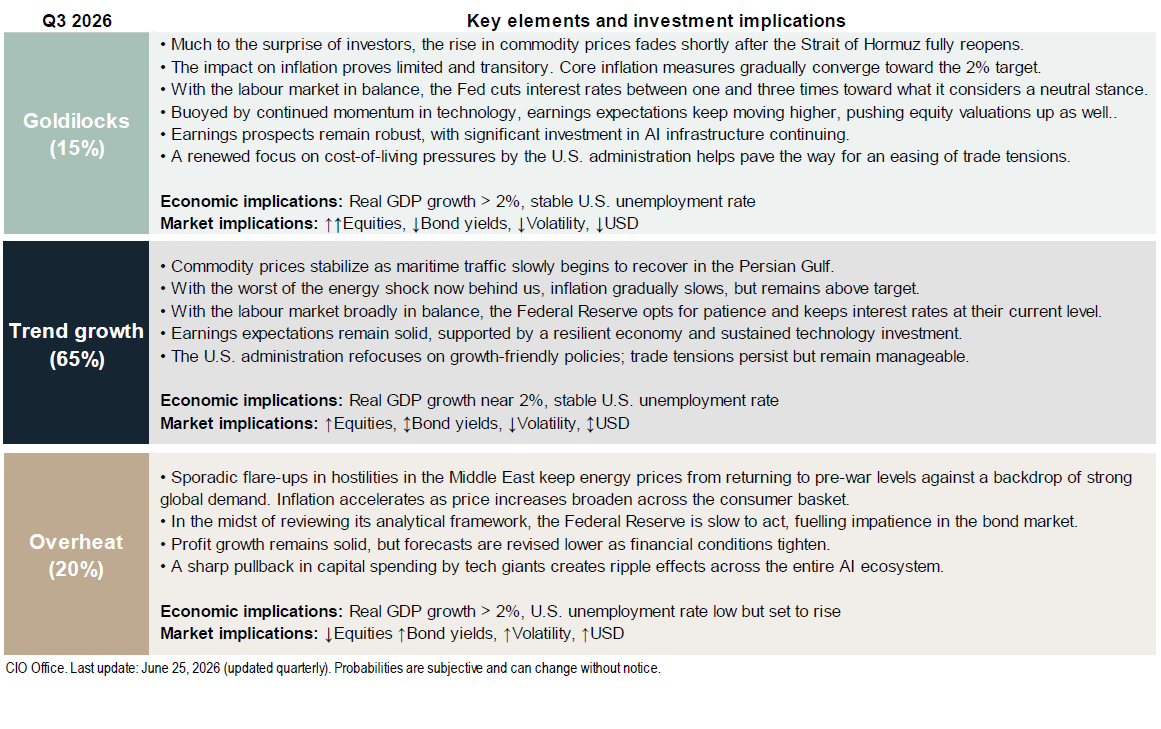
In summary, the environment remains favourable for measured risk-taking, but within a disciplined approach. Diversification remains highly relevant, especially in a market where recent gains are heavily driven by a few dominant themes, including artificial intelligence, semiconductors and certain equity regions that are more exposed to technology-driven growth.
Thank you for your trust. We remain available to discuss these perspectives and their impact on your portfolio.
Sincerely,
Cathy, Guillaume, Marc-Antoine and Inuk
514-871-3474