

A wave of selling hits markets
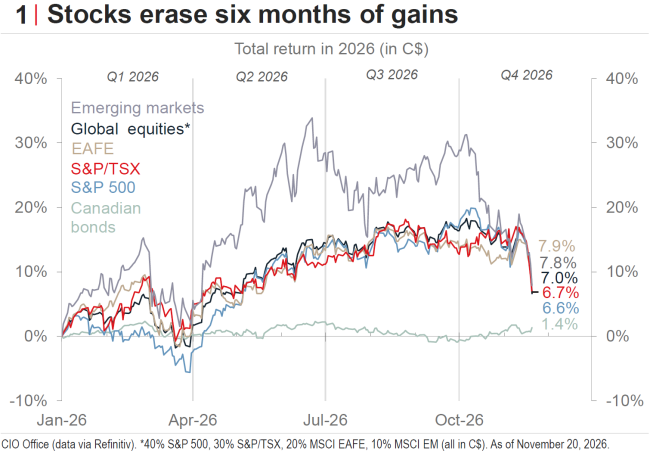
Last week, a significant sell-off, intensified by the scandal involving Nvidia, swept through equity markets, pushing the S&P 500 into correction territory for the first time since April 2025. For a global equity index measured in Canadian dollars, gains in 2026 remain positive, although they have been reduced by approximately half (Chart 1).
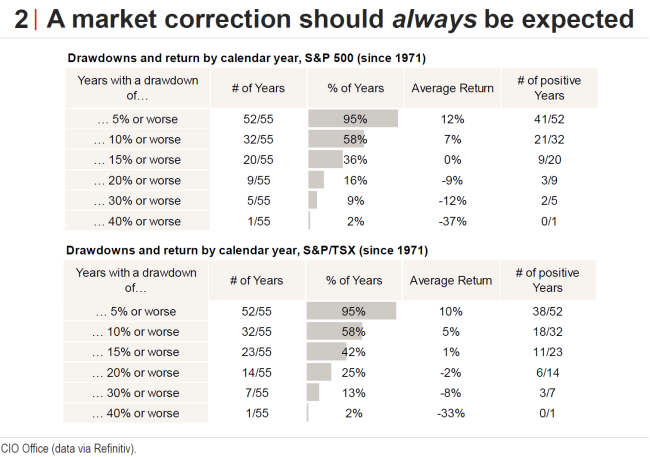
In such a volatile environment, it is worth remembering that market corrections are “normal.” On average, equity markets experience a decline of at least 10% in approximately six out of every ten years (Chart 2).
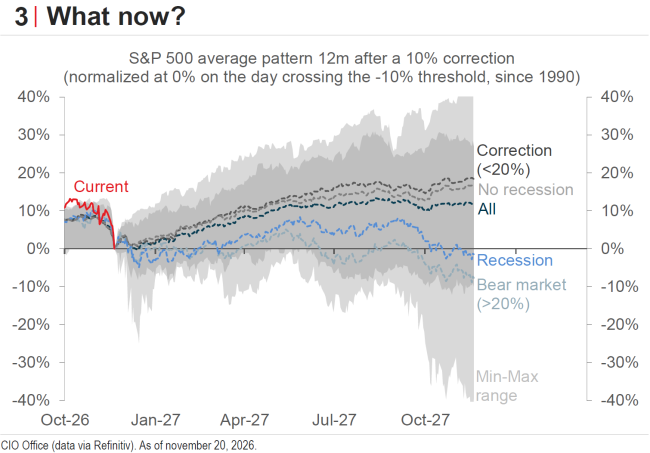
Moreover, based on historical averages, return prospects from the point at which the S&P 500 enters correction territory are generally positive over a period of several months, unless a recession emerges (Chart 3).
Now, although the news of Jensen Huang’s return at the helm of Nvidia provided significant reassurance to markets last Monday1, two important macroeconomic issues remain, and short-term volatility persists.
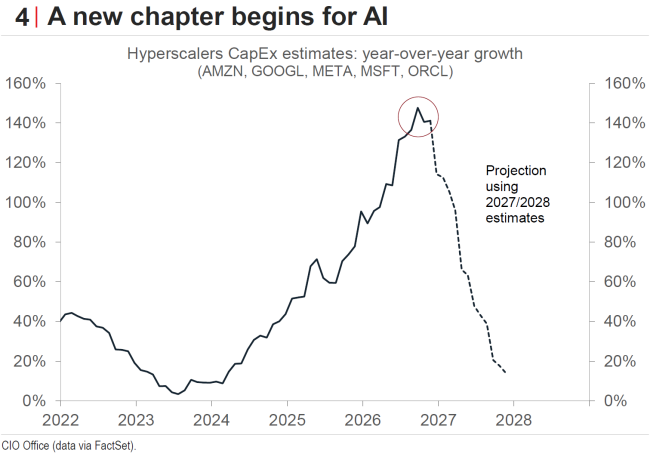
First, in light of the signals coming from financial markets and newly elected Democrats, it now appears clear that the peak in the growth rate of capital investment in artificial intelligence is behind us (Chart 4). This does not necessarily signal the end of the bull market, but it confirms that we have entered a new phase, characterized by potentially more modest, less concentrated and more volatile returns.
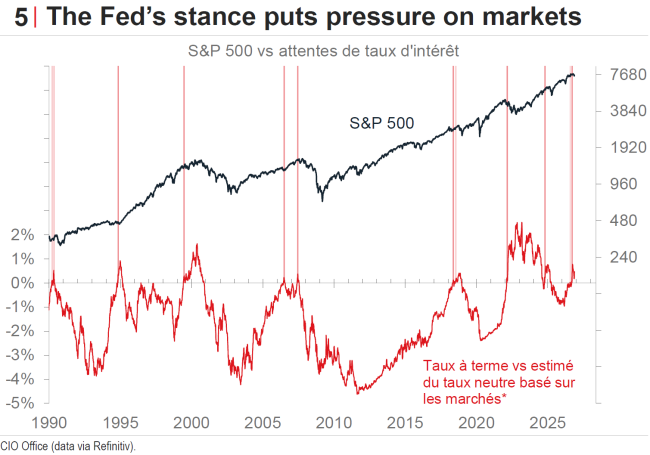
Second, the Federal Reserve’s stance, which is restraining economic growth through its “hawkish”2 rhetoric. While the objective of slowing inflation is a legitimate one, such an environment is generally symptomatic of heightened nervousness in equity markets (Chart 5).
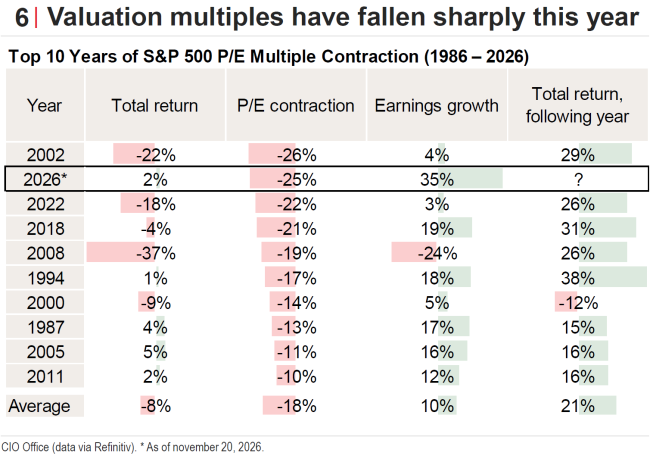
At the outset, it is worth noting that over the past four decades, only 2002 saw stock-market valuations decline more than they did in 2026. Thus, barring an abrupt shift in the economic outlook, equity markets could once again end up surprising on the upside (Chart 6).
1. As of 10:00 a.m. on November 23, the S&P 500 was up 4.6%, driven in part by a 32% jump in Nvidia’s share price.
2. Hawkish: refers to a more restrictive monetary policy approach, primarily aimed at containing inflation.
My team and I remain available to answer any questions. We will continue to closely monitor developments and keep you informed of any relevant elements as the situation evolves.
Sincerely,
Cathy, Guillaume, Marc-Antoine, Inuk & Éliane
514-871-3474
*This article is adapted from the National Bank Investments Chief Investment Office commentary published on November 23, 2026.
Disclaimer: National Bank Financial - Wealth Management (NBFWM) is a division of National Bank Financial Inc. (NBF), as well as a trademark owned by National Bank of Canada (NBC) that is used under license by NBF. NBF is a member of the Canadian Investment Regulatory Organization (CIRO) and the Canadian Investor Protection Fund (CIPF), and is a wholly-owned subsidiary of NBC, a public company listed on the Toronto Stock Exchange (TSX: NA).
The opinions expressed herein do not necessarily reflect those of National Bank Financial. The particulars contained herein were obtained from sources we believe to be reliable, but are not guaranteed by us and may be incomplete. The opinions expressed consider a number of factors including our analysis and interpretation of these particulars, such as historical data, and are not to be construed as a solicitation or offer to buy or sell the securities mentioned herein. Unit values and returns will fluctuate and past performance is not necessarily indicative of future performance. Important information regarding a fund may be found in the prospectus. The investor should read it before investing.